
How to Structure Google Ads Accounts for Maximum Performance
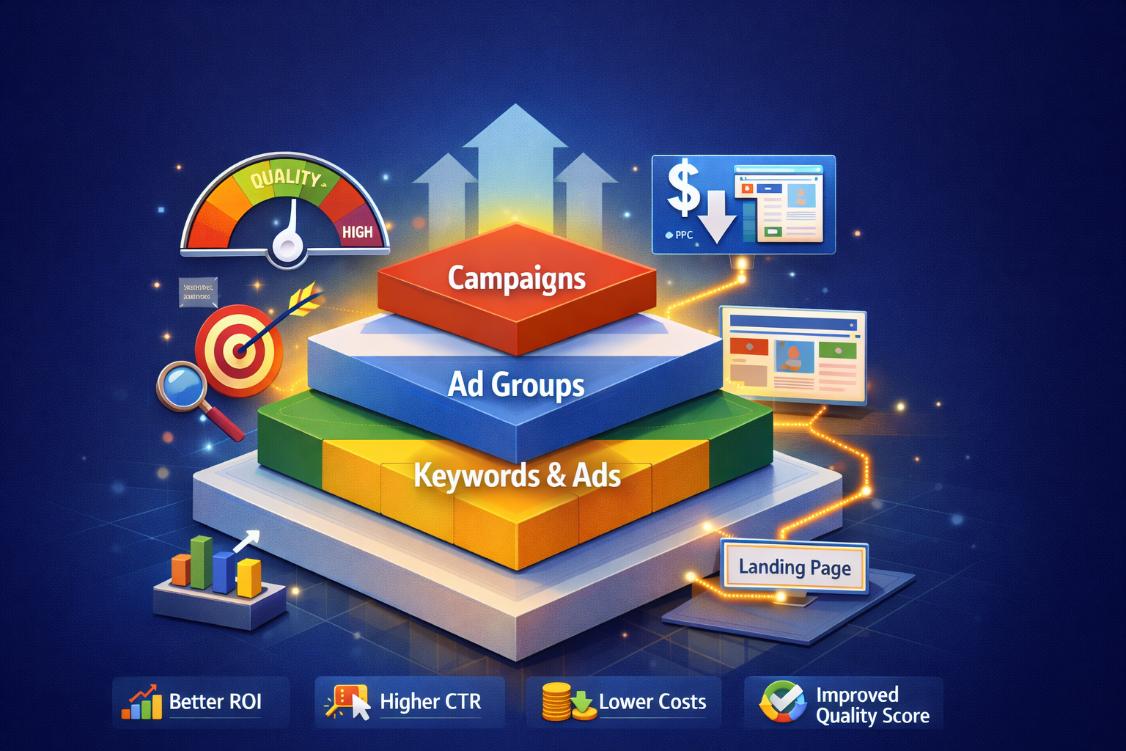
Many Google Ads campaigns fail not because of poor targeting or weak budgets, but due to a poorly structured account. Even with strong keywords and compelling ad copy, an unorganized Google Ads account can lead to low Quality Scores, high cost-per-click, and wasted ad spend. Account structure is the foundation that determines how efficiently your ads perform.
A well-planned Google Ads account structure improves relevance between keywords, ads, and landing pages. It gives advertisers better control over bidding, targeting, and optimization while allowing Google’s algorithm to deliver ads more effectively. Whether you manage ads for a small business or a large enterprise, proper structure is essential for long-term performance and scalability.
Why Google Ads Account Structure Matters
Google Ads rewards relevance and clarity. When campaigns and ad groups are structured logically, Google can better understand user intent and match ads to the right searches. It directly impacts Quality Score, ad rank, and overall campaign efficiency.
A strong account structure helps by:
- Improving keyword-to-ad relevance
- Increasing click-through rates (CTR)
- Lowering cost-per-click (CPC)
- Making optimization and scaling easier
Poor structure, on the other hand, leads to overlapping keywords, unclear performance data, and inefficient budget allocation.
Understanding the Google Ads Account Hierarchy
Before structuring an account, it’s important to understand how Google Ads is organized. Each level plays a specific role in performance and control.
At the top level is the account, which contains all billing and access settings. Within the account are campaigns, where you define budgets, locations, networks, and bidding strategies. Campaigns are divided into ad groups, which contain keywords and ads. This hierarchy ensures that targeting and messaging stay aligned.
When this structure is misused, such as placing unrelated keywords in one ad group or mixing objectives in one campaign, performance suffers.
Structuring Campaigns Based on Clear Objectives
Each Google Ads campaign should have a single, clear goal. Mixing different objectives within one campaign often leads to poor optimization and inaccurate performance analysis.
Campaigns are best structured around goals such as lead generation, sales, brand awareness, or remarketing. For example, search campaigns focused on lead generation should be separated from display or Performance Max campaigns aimed at awareness. This separation allows budgets, bidding strategies, and KPIs to remain aligned with campaign intent.
A clear campaign structure also helps Google’s automation optimize more effectively because it understands what success looks like for each campaign.
Organizing Ad Groups for Maximum Relevance
Ad groups are the core of a high-performing Google Ads account. Each ad group should focus on a tightly related set of keywords that share the same intent. It allows ads to match search queries, improving relevance and click-through rates directly.
Instead of grouping dozens of keywords, high-performing accounts use smaller, more focused ad groups. This approach ensures that ad copy closely reflects keyword intent and landing page messaging.
In many cases, advertisers benefit from using themed ad groups rather than overly broad structures. This balance allows for scalability without sacrificing relevance.
Keyword Organization and Match Type Strategy
Keyword selection and organization play a major role in performance. Keywords should be grouped based on intent, not just topic. For example, informational keywords should never be mixed with transactional keywords within the same ad group.
Match types should also be applied strategically. Broad match can be effective when paired with smart bidding and strong negative keywords, while phrase and exact match provide more control. A well-structured account separates match types logically to avoid internal competition and data confusion.
Using a clear keyword strategy helps reduce wasted spend and improves overall Google Ads performance.
Writing Ads That Match Structure and Intent
Ad copy should directly reflect the keywords and intent within each ad group. When ads are generic or disconnected from keyword themes, Quality Score drops and CPC increases.
Each ad group should have ads written specifically for its keyword set. This alignment improves relevance, click-through rates, and user experience. Responsive Search Ads perform best when headlines and descriptions are closely aligned with keyword intent and landing page messaging.
Strong structure ensures that ads are not forced to appeal to multiple intents at once, which weakens performance.
Aligning Landing Pages With Campaign Structure
Landing pages are an extension of your account structure. Sending traffic from multiple ad groups or campaigns to one generic page often reduces conversion rates and Quality Score.
Each campaign or ad group should ideally direct users to a landing page that matches their search intent. It improves user experience, reduces bounce rates, and increases conversion likelihood. When landing pages are aligned with keywords and ads, Google rewards campaigns with lower CPCs and higher ad visibility.
Proper alignment across keywords, ads, and landing pages is one of the most effective ways to improve ROI.
Using Negative Keywords to Protect Performance
Negative keywords are essential for maintaining a clean account structure. Without them, ads may appear for irrelevant searches, draining budget and skewing performance data.
A strong structure includes shared negative keyword lists applied at the campaign or account level. It prevents overlap between campaigns and ensures each campaign targets only its intended audience.
Regular review of search term reports helps identify new negatives and keeps the account optimized over time.
Structuring Accounts for Scalability and Growth
A well-structured Google Ads account should be built with future growth in mind. As campaigns scale, structure becomes even more important to avoid complexity and inefficiency.
Scalable accounts use consistent naming conventions, logical campaign segmentation, and clear documentation. It makes it easier to onboard new team members, expand into new markets, or launch additional services without disrupting performance.
Google Ads accounts that are built for scalability tend to perform more consistently during algorithm updates and budget increases.
Common Google Ads Structuring Mistakes to Avoid
Many advertisers unknowingly harm performance through poor structural decisions. Common issues include overcrowded ad groups, mixing different goals in one campaign, and sending all traffic to one landing page.
Other mistakes include ignoring negative keywords, duplicating keywords across campaigns, and failing to separate branded and non-branded traffic. Avoiding these issues improves clarity, control, and optimization potential.
Regular account audits help identify and correct structural problems before they impact results.
How Proper Structure Improves Long-Term Performance
A clean and logical Google Ads account structure improves more than short-term results. It creates a foundation for consistent optimization, better automation performance, and sustainable growth.
Well-structured accounts achieve higher Quality Scores, lower CPCs, and stronger conversion rates over time. They also make it easier to test new strategies, adopt automation, and scale budgets with confidence.
For businesses serious about paid advertising success, structure is not optional—it is essential.
Conclusion
Structuring your Google Ads account correctly is one of the most powerful ways to improve performance, control costs, and increase conversions. A clear hierarchy, focused ad groups, aligned landing pages, and a strong keyword strategy allow both advertisers and Google’s algorithm to work more effectively.
By investing time in building and maintaining a clean Google Ads account structure, businesses can unlock higher ROI, better scalability, and long-term advertising success. In competitive markets, proper structure is often the difference between wasted budget and profitable growth.
FAQS
What is the ideal Google Ads account structure?
The ideal Google Ads account structure includes clearly separated campaigns based on goals, tightly themed ad groups, relevant keywords, and ads that match user intent and landing pages.
How many keywords should be in one Google Ads ad group?
Most high-performing ad groups contain a small number of closely related keywords, usually between five and fifteen, to maintain strong relevance and improve Quality Score.
Should I separate campaigns by product or service?
Yes, separating campaigns by product or service allows better budget control, clearer performance analysis, and more precise bidding and optimization.
How does account structure affect Quality Score?
A strong account structure improves relevance between keywords, ads, and landing pages, which directly increases Quality Score and reduces cost-per-click.
Can a poor Google Ads structure waste budget?
Yes, a poorly structured account often leads to irrelevant clicks, low conversion rates, and higher costs due to weak targeting and low Quality Scores.