Microsoft Unveils Aggressive “College Offer” Bundle to Challenge Apple’s MacBook Neo
Dateline: April 16, 2026 | Location: Redmond, WA | Author: Tech Editorial Team
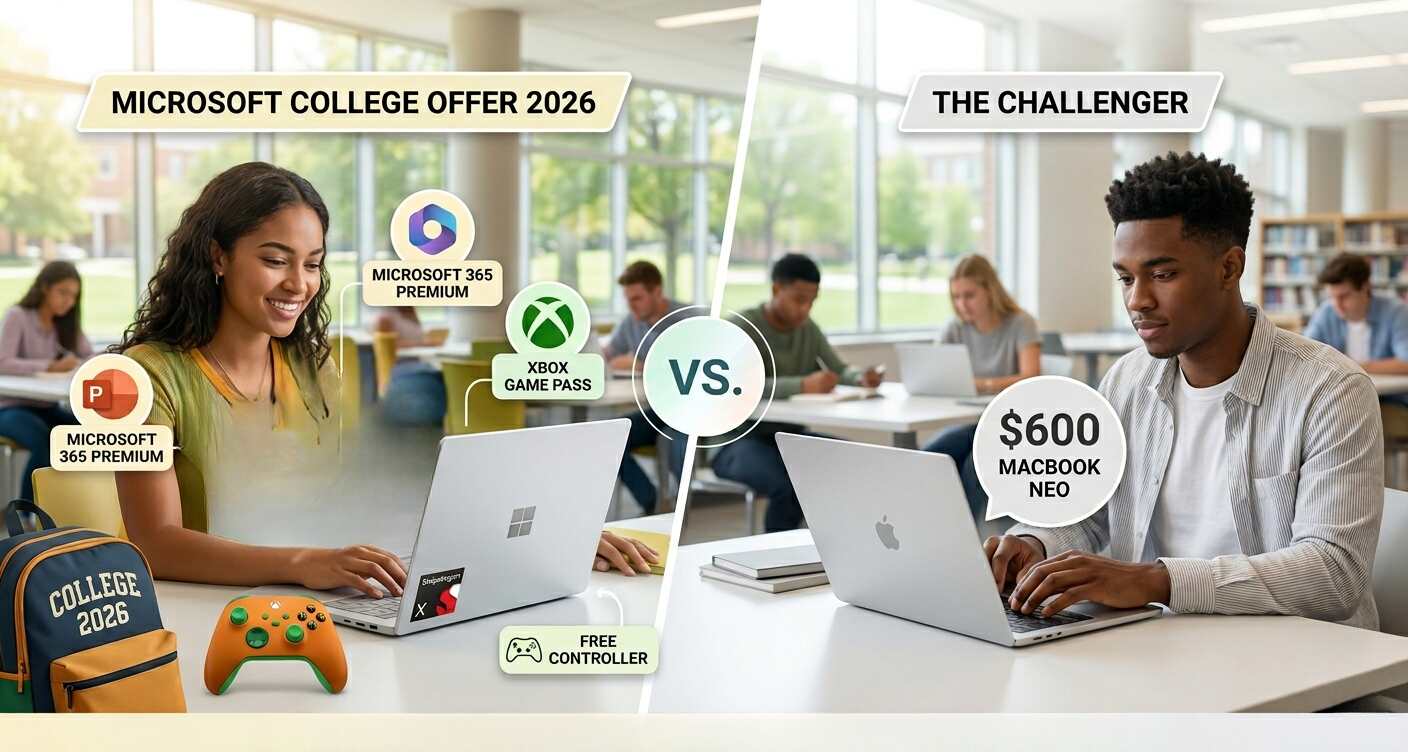
In a direct response to Apple’s disruptive $600 MacBook Neo, Microsoft has officially launched the Microsoft College Offer 2026. This strategic campaign aims to reclaim the student market by pairing discounted Windows hardware with a high-value services bundle. Running from April 15 through June 30, 2026, the offer provides students with up to $500 in added value, including a year of Microsoft 365 Premium, Xbox Game Pass Ultimate, and a custom Xbox controller.
As technology providers shift their strategies to capture the next generation of users, Quaid Technologies plays a pivotal role in helping educational institutions and enterprises navigate these large-scale hardware transitions. Through our expert Designing & Branding services, we help organizations create cohesive digital identities and user-centric interfaces that perform flawlessly across both Windows and MacBook ecosystems, ensuring that regardless of the hardware a student chooses, their visual and functional experience remains premium, consistent, and engaging.
Get a FREE interview of top 3 candidates.
Developers, QA, DevOps, Designers, PMs & more.
Pre-vetted remote talent. Fast onboarding. Flexible scaling.
Hardware Discounts and Partner Value
The Microsoft College Offer 2026 isn’t limited to Microsoft’s own Surface line. The company has partnered with major retailers and OEMs to drive down hardware costs:
- Best Buy: Offering the Lenovo IdeaPad Slim 3x (Snapdragon X, 16GB RAM) for just $500—a $250 discount.
- Walmart: Features the HP Omnibook 3 at a staggering $429, down from its usual $699 price point.
- Surface Deals: While less aggressive than third-party partners, Microsoft is also offering direct discounts on Surface Laptops and tablets as part of the student bundle.
The Service Bundle: A Double-Edged Sword
While the hardware discounts are straightforward, the services bundle is more complex. Microsoft 365 Premium (a $200 value) is a strong addition, though its utility depends on whether a student’s university already provides these apps. The inclusion of a year of Xbox Game Pass Ultimate—valued at $30 per month as of late 2025—is a significant draw for gamers, though it is strictly reserved for new subscribers. The most tangible “freebie” for all remains the custom Xbox controller, valued at approximately $76.
Strategic Market Competition
This move signals a broader “laptop war” in the 2026 academic market. While Apple relies on its premium brand identity and the low entry price of the Neo, Microsoft is betting on a “total ecosystem” value. By combining work, play, and hardware discounts, Windows PC makers are attempting to prove that a $500 Windows machine offers more “bang for the buck” than the entry-level MacBook.
The Future of Student Computing: ARM-Based Performance
One of the most significant technical shifts highlighted by the Microsoft College Offer 2026 is the transition toward ARM-based processing in affordable hardware. Both the MacBook Neo and the Lenovo IdeaPad Slim 3x (powered by the Snapdragon X chip) represent a move away from traditional x86 architecture for the average consumer.
This transition offers three key benefits for the 2026 student market:
- Extended Battery Life: ARM-based laptops are now reaching 20+ hours of real-world use, allowing students to go multiple days without needing a charger.
- Instant-On Capability: These devices function more like smartphones, waking from sleep instantly and maintaining background data synchronization without draining the battery.
- Thermal Efficiency: Because these chips generate significantly less heat, many of the new laptops in the Microsoft bundle are fanless, making them completely silent for library or classroom use.
As the software ecosystem catches up, with most major creative and productivity apps now running natively on ARM, the “performance gap” that once existed between high-end workstations and student laptops has narrowed significantly. The 2026 academic year marks the first time that $500–$600 machines offer the same responsiveness and efficiency previously reserved for $1,500 flagship devices.
Related Tech Stories